The Healthcare Chatbot Market is Predict to reach USD 6.22 Billion by 2032, at a CAGR of 23.7%
Special Offering :
Industry Insights | Market Trends | Highest number of Tables | 24/7 Analyst Support
Healthcare Chatbot Market Growth, Trends and Report Highlights
According to a new report, published by KBV research, The Global Healthcare Chatbot Market size is expected to reach $6.22 billion by 2032, rising at a market growth of 23.7% CAGR during the forecast period.
The Software segment captured the maximum revenue in the Global Healthcare Chatbot Market by Component in 2024, thereby, achieving a market value of $4.00 billion by 2032. Globally, software forms the foundation of healthcare chatbot systems, providing the natural language processing (NLP), AI, and machine learning engines that drive intelligent conversations. Software platforms like Microsoft Azure Health Bot, Google Dialogflow, and AWS Lex enable hospitals, insurers, and health tech firms to build custom chatbot solutions capable of multilingual triage, medical advice, and administrative automation.
The Medical Data Repositories segment is experiencing a CAGR of 22.7 % during the forecast period. Globally, chatbots connected to medical data repositories have become essential tools in improving care efficiency and personalization. These bots access structured health information such as EHRs, lab results, and patient histories, enabling them to provide real-time clinical insights and decision support.
The Cloud segment led the maximum revenue in the Global Healthcare Chatbot Market by Deployment in 2024, thereby, achieving a market value of $4.06 billion by 2032. Cloud deployment dominates globally due to its scalability, rapid implementation, and cost-efficiency. It allows healthcare providers to launch AI-driven chatbots quickly without the need for on-site infrastructure. Platforms like Microsoft Azure Health Bot and AWS HealthLake have been widely adopted for triage, screening, and appointment management, especially during public health emergencies like COVID-19.
The Healthcare providers segment is growing at a CAGR of 22.7 % during the forecast period. Globally, hospitals, clinics, and telemedicine platforms are adopting chatbots to automate repetitive tasks and reduce administrative burdens. Leading institutions like Cleveland Clinic (USA), NHS (UK), and Apollo Hospitals (India) integrate AI chatbots for pre-diagnosis, appointment booking, patient navigation, and lab test scheduling.
Full Report: https://www.kbvresearch.com/healthcare-chatbot-market/
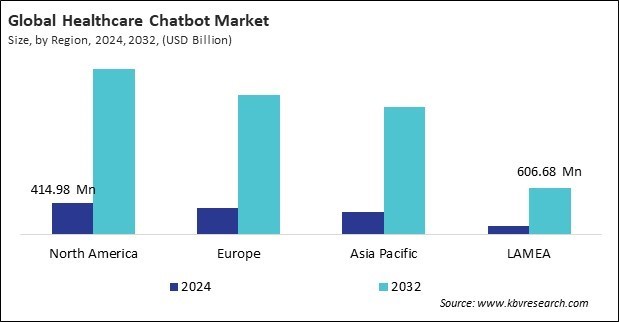
The North America region dominated the Global Healthcare Chatbot Market by Region in 2024, thereby, achieving a market value of $2.14 billion by 2032. The Europe region is anticipated to grow a CAGR of 23.4% during (2025 - 2032). Additionally, The Asia Pacific region would witness a CAGR of 24.3% during (2025 - 2032).
List of Key Companies Profiled
- Ada Health GmbH
- Healthily LTD.
- Babylon Healthcare Services Ltd. (eMed)
- Woebot Labs, Inc. (Woebot Health)
- TECKEL MEDICAL S.L. (Mediktor)
- HealthTap, Inc.
- Luka, Inc. (Replika)
- K Health, Inc.
- BytePlus Pte Ltd.
- Fabric Labs, Inc. (Fabric)
Healthcare Chatbot Market Report Segmentation
By Component
- Software
- Services
By Application
- Medical Data Repositories
- Automated patient support
- Personal Assistance
- Other Application
By Deployment
- Cloud
- On-Premises
By End-use
- Healthcare providers
- Patients
- Insurance companies
- Other End-use
By Geography
- North America
- US
- Canada
- Mexico
- Rest of North America
- Europe
- Germany
- UK
- France
- Russia
- Spain
- Italy
- Rest of Europe
- Asia Pacific
- China
- Japan
- India
- South Korea
- Singapore
- Malaysia
- Rest of Asia Pacific
- LAMEA
- Brazil
- Argentina
- UAE
- Saudi Arabia
- South Africa
- Nigeria
- Rest of LAMEA
Related Reports: