The Extended Detection and Response (XDR) Market is Predicted to reach USD 49.56 Billion by 2032, at a CAGR of 31.0%
Special Offering :
Industry Insights | Market Trends | Highest number of Tables | 24/7 Analyst Support
Extended Detection and Response (XDR) Market Growth, Trends and Report Highlights
According to a new report, published by KBV research, The Global Extended Detection and Response (XDR) Market size is expected to reach $49.56 billion by 2032, rising at a market growth of 31.0% CAGR during the forecast period.
The concept of Extended Detection and Response (XDR) has evolved as a direct response to the growing complexity and volume of cyber threats targeting global enterprises. Initially, organizations relied heavily on endpoint detection and response (EDR) and security information and event management (SIEM) tools to manage incidents. However, as digital infrastructures expanded across cloud, on-premises, and hybrid environments, these traditional systems became inadequate in providing a unified threat visibility.
The Large Enterprises segment is poised to grow at a CAGR of 30.7 % during the forecast period. This segment is defined by organizations with substantial IT infrastructures and heightened cybersecurity needs. These enterprises typically manage a vast amount of sensitive data and operate across multiple geographies, making them prime targets for complex cyber threats. As a result, they adopt XDR solutions to centralize, automate, and strengthen their threat detection and response capabilities.
The Solutions segment captured the maximum revenue in the Global Extended Detection and Response (XDR) Market by Component in 2024, thereby, achieving a market value of $30.8 billion by 2032. These solutions encompass integrated platforms that merge data across endpoints, networks, servers, and email to provide a centralized view of security threats. Organizations are increasingly drawn to XDR solutions due to their ability to streamline threat detection, automate responses, and enhance visibility across the security landscape.
The On-Premises segment is experiencing a CAGR of 30.5 % during the forecast period. Enterprises operating in sectors such as banking, government, defense, and healthcare often prefer on-premises XDR solutions due to the high degree of control they offer over security infrastructure and data storage. These solutions allow organizations to tailor configurations, integrate with legacy systems, and ensure compliance with regulatory mandates that restrict data transfer outside their premises.
The Endpoint Security segment led the maximum revenue in the Global Extended Detection and Response (XDR) Market by Attack Surface Coverage in 2024, thereby, achieving a market value of $14.0 billion by 2032. Endpoint security forms the foundation of XDR solutions, enabling continuous monitoring, advanced analytics, and automated threat response at the device level. With the rise of remote work, bring-your-own-device (BYOD) policies, and increasing ransomware incidents, global enterprises are prioritizing endpoint protection to prevent data breaches and ensure operational continuity.
The BFSI segment is growing at a CAGR of 28.3 % during the forecast period. Financial institutions manage vast volumes of sensitive data and digital transactions, making them prime targets for phishing, ransomware, and advanced persistent threats (APTs). XDR solutions help BFSI organizations integrate threat detection across endpoints, networks, and cloud systems to ensure real-time monitoring and response. The global shift toward digital banking and the rise of fintech innovations are further intensifying the need for comprehensive threat visibility and proactive defense mechanisms within this segment.
Full Report: https://www.kbvresearch.com/extended-detection-and-response-market/
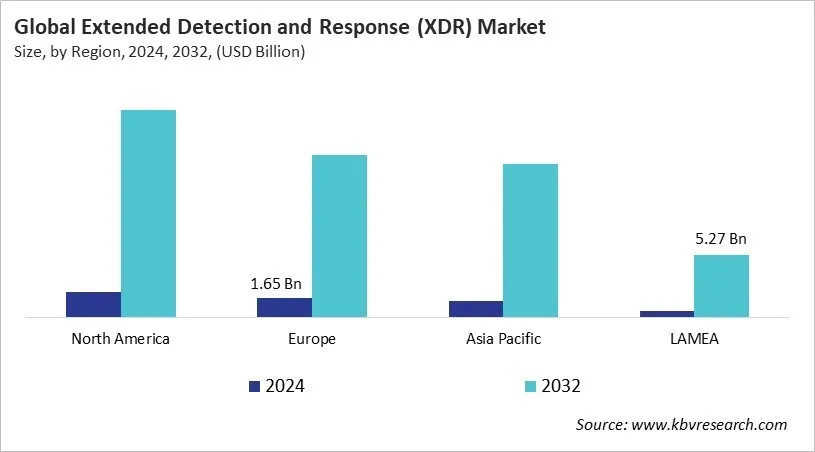
The North America region dominated the Global Extended Detection and Response (XDR) Market by Region in 2024, and would continue to be a dominant market till 2032; thereby, achieving a market value of $17.6 billion by 2032. The Europe region is anticipated to grow at a CAGR of 30.6% during (2025 - 2032). Additionally, The Asia Pacific region would witness a CAGR of 31.8% during (2025 - 2032).
List of Key Companies Profiled
- CrowdStrike Holdings, Inc.
- Trend Micro, Inc.
- Sophos Group PLC (Thoma Bravo)
- Palo Alto Networks, Inc.
- SentinelOne, Inc.
- Cisco Systems, Inc.
- Microsoft Corporation
- Fortinet, Inc.
- IBM Corporation
- Cybereason Inc.
Extended Detection and Response (XDR) Market Report Segmentation
By Organization Size
- Large Enterprises
- Small & Medium Enterprises (SMEs)
By Component
- Solutions
- Services
By Deployment Type
- On-Premises
- Cloud-based
- Hybrid
By Attack Surface Coverage
- Endpoint Security
- Network Security
- Cloud Security
- Identity & Access Security
- IoT/OT Security & Others
By Industry Vertical
- BFSI
- IT & Telecom
- Government & Defense
- Healthcare
- Retail & eCommerce
- Manufacturing & Energy
- Other Industry Vertical
By Geography
- North America
- US
- Canada
- Mexico
- Rest of North America
- Europe
- Germany
- UK
- France
- Russia
- Spain
- Italy
- Rest of Europe
- Asia Pacific
- China
- Japan
- India
- South Korea
- Singapore
- Malaysia
- Rest of Asia Pacific
- LAMEA
- Brazil
- Argentina
- UAE
- Saudi Arabia
- South Africa
- Nigeria
- Rest of LAMEA
Related Reports: