The Building Information Modeling Market is Predicted to reach USD 18.94 Billion by 2032, at a CAGR of 11.3%
Special Offering :
Industry Insights | Market Trends | Highest number of Tables | 24/7 Analyst Support
Building Information Modeling Market Growth, Trends and Report Highlights
According to a new report, published by KBV research, The Global Building Information Modeling Market size is expected to reach USD 18.94 billion by 2032, rising at a market growth of 11.3% CAGR during the forecast period.
Major OEMs and software providers, for example Autodesk—describe BIM as the holistic process of creating and managing digital representations of built assets across their lifecycle, enabled by models, data, platforms and cloud collaboration. As a result, the BIM market has matured from isolated modelling tools to integrated platforms supporting design, construction coordination, asset-management, facility operations, sustainability analysis and smart building delivery.
The Software segment is leading the Global Building Information Modeling Market by Component in 2024, growing at a CAGR of 11 % during the forecast period. This is primarily due to the increasing adoption of digital construction tools across Latin America, the Middle East, and Africa. The software component remains the foundation of BIM integration, supporting advanced design modeling, simulation, and collaboration across large-scale infrastructure and commercial projects.
The On-premises segment led the Global Building Information Modeling Market by Deployment in 2024, thereby achieving a market value of $9,764.5 million by 2032. As many large enterprises, government organizations, and infrastructure operators in the Middle East and Africa preferred in-house data management and secure servers. This model offers greater control over data security and customization, which is crucial for public-sector projects, energy facilities, and defense-related construction. Additionally, hybrid deployment models—combining local servers with limited cloud integration—have gained traction across LAMEA, particularly in countries like Saudi Arabia and Brazil, where regulatory compliance and cybersecurity are key priorities.
The Pre-Construction segment is registering the maximum revenue share in the Global Building Information Modeling Market by Project Lifecycle in 2024, growing at a CAGR of 10.7 % during the forecast period. This reflects its pivotal role in planning, design coordination, and cost estimation across infrastructure and building projects in Latin America, the Middle East, and Africa. During this phase, BIM enables architects, engineers, and contractors to visualize designs, detect clashes, and optimize material use before physical construction begins. The segment’s dominance is supported by growing government mandates requiring BIM implementation in early project stages to improve accuracy and sustainability outcomes—particularly in countries such as Saudi Arabia, the UAE, and Brazil.
The Commercial segment is generating maximum revenue share in the Global Building Information Modeling Market by Building Type in 2024; thereby, achieving a market value of $6.87 billion by 2032. The dominance of this category is attributed to the growing construction of office complexes, retail centers, hospitality buildings, and developments across Latin America, the Middle East, and Africa. Governments and private developers are widely adopting BIM for commercial projects to enhance energy efficiency, sustainability, and lifecycle cost management.
The Designing segment led the Global Building Information Modeling Market by Application in 2024, growing at a CAGR of 10.5 % during the forecast period. This segment’s leadership is attributed to the widespread use of BIM tools in the early design and conceptualization stages of construction projects across Latin America, the Middle East, and Africa. BIM software enables architects and engineers to visualize 3D models, conduct design validation, and perform sustainability simulations to optimize energy performance.
Full Report: https://www.kbvresearch.com/building-information-modeling-market/
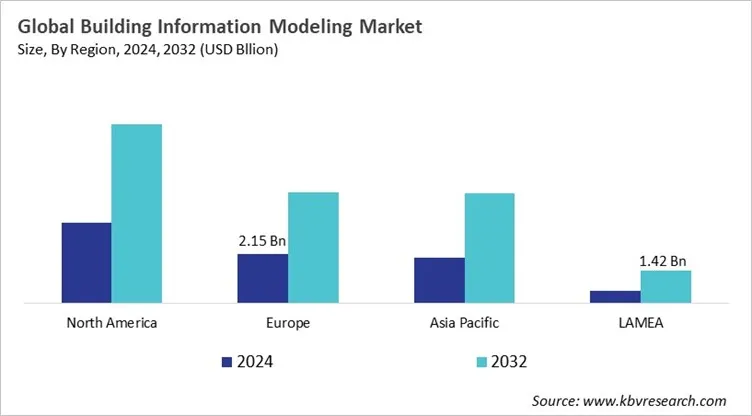
The North America region dominated the Global Building Information Modeling Market by Region in 2024, and would continue to be a dominant market till 2032; thereby, achieving a market value of $7.85 billion by 2032. The Europe region is experiencing a CAGR of 10.9% during (2025 - 2032). Additionally, The Asia Pacific region would exhibit a CAGR of 11.9% during (2025 - 2032).
List of Key Companies Profiled
- Autodesk, Inc.
- Trimble, Inc.
- Bentley Systems, Inc.
- AECOM Corporation
- Procore Technologies, Inc.
- RIB Software GmbH (Schneider Electric Investment AG)
- Hexagon AB
- Dassault Systemes SE
- Jacobs Engineering Group, Inc.
- Nemetschek Group
Building Information Modeling Market Report Segmentation
By Component
- Software
- Services
- Professional Services
- Managed Services
By Deployment
- On-premises
- Cloud
By Project Lifecycle
- Pre-Construction
- Construction
- Operation
By Building Type
- Commercial
- Industrial
- Government / Infrastructure
- Residential
By Application
- Designing
- Planning & Modeling
- Asset Management
- Other Application
By Geography
- North America
- US
- Canada
- Mexico
- Rest of North America
- Europe
- Germany
- UK
- France
- Russia
- Spain
- Italy
- Rest of Europe
- Asia Pacific
- China
- Japan
- India
- South Korea
- Singapore
- Malaysia
- Rest of Asia Pacific
- LAMEA
- Brazil
- Argentina
- UAE
- Saudi Arabia
- South Africa
- Nigeria
- Rest of LAMEA
Related Reports: