The Aerospace Testing Market is Predict to reach USD 8.71 Billion by 2032, at a CAGR of 4.6%
Special Offering :
Industry Insights | Market Trends | Highest number of Tables | 24/7 Analyst Support
Aerospace Testing Market Growth, Trends and Report Highlights
According to a new report, published by KBV research, The Global Aerospace Testing Market size is expected to reach USD 8.71 billion by 2032, rising at a market growth of 4.6% CAGR during the forecast period.
The aerospace testing market has grown out of the fundamental need for safety, performance, and regulatory compliance in aviation and space industries. In the early days of aviation, testing was primarily conducted by government agencies and defense establishments, focusing on airworthiness, structural strength, and safety of military aircraft. Over time, as civil aviation expanded and new technologies emerged, testing became more structured and standardized, integrating advanced engineering practices and dedicated testing facilities. The introduction of international aviation standards provided a framework for consistent testing methods, ensuring global reliability.
The Aircraft Structures segment is leading the Global Aerospace Testing Market by Application in 2024; thereby, achieving a market value of $3.09 billion by 2032. The aircraft structures segment stands as the leading part of the aerospace testing market, as it deals with the validation of critical components like wings, fuselage, and airframes. This testing ensures that aircraft can withstand stress, pressure, and harsh environmental conditions. It is crucial for both commercial and defense aviation since structural integrity directly impacts safety and reliability. The focus on durability and compliance with strict aviation standards keeps this segment at the forefront.
The Material Testing segment acquired maximum revenue share in the Global Aerospace Testing Market by Testing Type in 2024, growing at a CAGR of 3.7 % during the forecast period. Material testing represents a major part of the aerospace testing market, focusing on verifying the strength, durability, and reliability of metals, composites, and alloys used in aircraft and spacecraft. This testing ensures that materials can endure extreme pressures, temperatures, and operational stresses. It is vital for safety and efficiency, as the choice of materials directly impacts performance. With the growing use of advanced composites, material testing remains a cornerstone of the industry.
The OEMs segment is leading the Global Aerospace Testing Market by End Use in 2024, thereby, achieving a market value of $2.23 billion by 2032. OEMs form a major segment of the aerospace testing market, as original equipment manufacturers are responsible for developing and certifying new aircraft and components. Testing at this stage ensures compliance with global safety and performance standards before products enter service. It covers everything from materials and structures to electronics and propulsion systems. The rising production of next-generation aircraft and increasing use of advanced composites make OEM testing indispensable. This segment serves as the foundation for overall industry reliability.
The Commercial Aviation segment registered maximum revenue in the Global Aerospace Testing Market by Aviation Type in 2024, growing at a CAGR of 4.1 % during the forecast period. Commercial aviation forms the largest segment of the aerospace testing market, driven by the rising demand for safe, reliable, and efficient passengers and cargo aircraft. Testing in this category covers airframes, engines, avionics, and interiors to ensure compliance with strict international regulations. The growth of global air travel and the need for fuel-efficient designs further expand the scope of testing.
Full Report: https://www.kbvresearch.com/aerospace-testing-market/
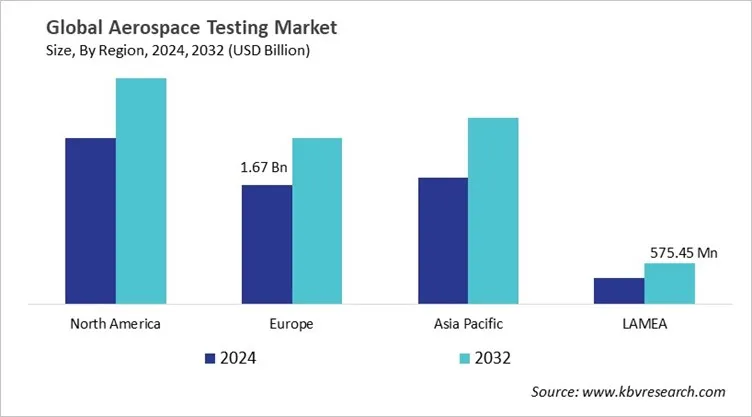
The North America region dominated the Global Aerospace Testing Market by Region in 2024, and would continue to be a dominant market till 2032; thereby, achieving a market value of $3.17 billion by 2032. The Asia Pacific region is experiencing a CAGR of 5.1% during (2025 - 2032). Additionally, The Europe region would exhibit a CAGR of 4.4% during (2025 - 2032).
List of Key Companies Profiled
- Element Materials Technology (Temasek Holdings)
- SGS S.A.
- Intertek Group PLC
- Applus+ Group
- The Boeing Company
- Lockheed Martin Corporation
- Rolls-Royce Plc (Rolls-Royce Holdings Plc)
- Airbus SE
- Mistras Group, Inc.
- Bureau Veritas S.A.
Aerospace Testing Market Report Segmentation
By Application
- Aircraft Structures
- Avionics & Electronics
- Propulsion Systems
- Space Systems
- Interiors
By Testing Type
- Material Testing
- Structural/Component Testing
- Environmental Testing
- Electromagnetic Compatibility (EMC) Testing
- Software Testing
- Other Testing Type
By End Use
- OEMs
- MROs (Maintenance, Repair & Overhaul)
- Airlines & Defense Operators
- Government & Space Agencies
- Other End Use
By Aviation Type
- Commercial Aviation
- Military Aviation
- Space Exploration
- Other Aviation Type
By Geography
- North America
- US
- Canada
- Mexico
- Rest of North America
- Europe
- Germany
- UK
- France
- Russia
- Spain
- Italy
- Rest of Europe
- Asia Pacific
- China
- Japan
- India
- South Korea
- Singapore
- Malaysia
- Rest of Asia Pacific
- LAMEA
- Brazil
- Argentina
- UAE
- Saudi Arabia
- South Africa
- Nigeria
- Rest of LAMEA
Related Reports: