The 5G In Aviation Market is Predict to reach USD 21.51 Billion by 2032, at a CAGR of 30.8%
Special Offering :
Industry Insights | Market Trends | Highest number of Tables | 24/7 Analyst Support
5G In Aviation Market Growth, Trends and Report Highlights
According to a new report, published by KBV research, The Global 5G In Aviation Market size is expected to reach $21.51 billion by 2032, rising at a market growth of 30.8% CAGR during the forecast period.
The integration of 5G technology in the aviation sector represents one of the most transformative evolutions in recent years, offering unprecedented opportunities to enhance efficiency, safety, connectivity, and customer experience. As global demand for air travel rebounds and grows in complexity, the aviation industry is undergoing a digital metamorphosis that places real-time data, seamless connectivity, and autonomous systems at the core of operational and service innovation.
The Air-to-Ground Communication segment is leading the Global 5G In Aviation Market by Connectivity Type in 2024; thereby, achieving a market value of $10.78 billion by 2032. Air-to-ground communication refers to the transmission of data between aircraft and ground-based stations using 5G technology. This connectivity type plays a critical role in enhancing in-flight connectivity for passengers and supporting real-time data exchange for flight operations. With the capabilities of 5G, air-to-ground links can provide high-speed internet access, enabling passengers to stream video, browse the internet, and use communication apps while airborne.
The Distributed Antenna Systems (DAS) segment is registering a CAGR of 31% during (2025 - 2032). Distributed Antenna Systems consist of multiple antenna nodes connected to a common source, strategically distributed to enhance signal strength and coverage over large or complex structures. In aviation, DAS is particularly effective in large airports where maintaining consistent network performance is critical. It supports seamless 5G connectivity by eliminating dead zones, improving network reliability, and facilitating high-bandwidth applications across terminals, baggage handling areas, and control rooms.
The Enhanced Mobile Broadband (eMBB) segment is generating the maximum revenue share in the Global 5G In Aviation Market by Technology in 2024; thereby, achieving a market value of $12.55 billion by 2032. Enhanced Mobile Broadband (eMBB) focuses on delivering high-speed internet access and data throughput to support bandwidth-intensive applications. In aviation, eMBB is primarily utilized to improve the passenger experience by enabling seamless in-flight entertainment, video streaming, high-speed browsing, and real-time communication. It also supports operational efficiency through fast data transfers for flight management systems, crew communications, and airport services. eMBB forms the foundation for many 5G-enabled services in both airborne and ground environments.
The Airport segment is anticipating a CAGR of 31.5% during (2025 - 2032). In the airport segment, 5G is utilized to optimize ground operations, streamline logistics, and improve the passenger journey. It enables smart infrastructure solutions such as automated check-ins, baggage handling, facial recognition for security, and real-time information systems. With ultra-fast and reliable connectivity, airports can deploy IoT networks for surveillance, facility management, and emergency response. The implementation of 5G helps enhance efficiency, reduce delays, and deliver a seamless and secure travel experience for passengers and staff alike.
Full Report: https://www.kbvresearch.com/5g-in-aviation-market/
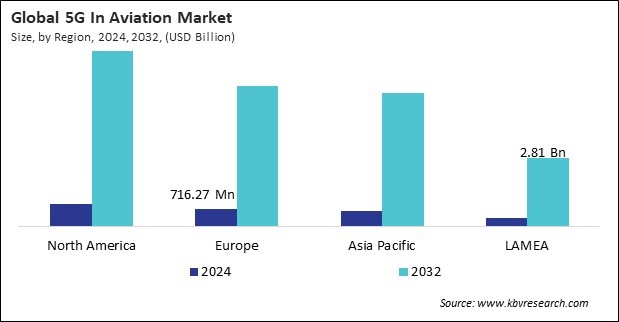
The North America region dominated the Global 5G In Aviation Market by Region in 2024, and would continue to be a dominant market till 2032; thereby, achieving a market value of $7.30 billion by 2032. The Europe region is experiencing a CAGR of 30.6% during (2025 - 2032). Additionally, The Asia Pacific region would exhibit a CAGR of 31.5% during (2025 - 2032).
List of Key Companies Profiled
- Huawei Technologies Co., Ltd. (Huawei Investment & Holding Co., Ltd.)
- Nokia Corporation
- Cisco Systems, Inc.
- Honeywell International Inc.
- Thales Group S.A.
- Ericsson AB
- Panasonic Holdings Corporation
- NTT Data Corporation
- OneWeb Holdings Ltd
- Collins Aerospace (RTX Corporation)
5G In Aviation Market Report Segmentation
By Connectivity Type
- Air-to-Ground Communication
- Ground-to-Ground Communication
By Communication Infrastructure
- Small Cells
- Distributed Antenna Systems (DAS)
- Radio Access Network (RAN)
By Technology
- Enhanced Mobile Broadband (eMBB)
- Ultra-Reliable Low-Latency Communication (URLLC)
- Massive Machine-Type Communication (mMTC)
By End Use
- Aircraft
- Airport
By Geography
- North America
- US
- Canada
- Mexico
- Rest of North America
- Europe
- Germany
- UK
- France
- Russia
- Spain
- Italy
- Rest of Europe
- Asia Pacific
- China
- Japan
- India
- South Korea
- Singapore
- Malaysia
- Rest of Asia Pacific
- LAMEA
- UAE
- Qatar
- Brazil
- Saudi Arabia
- South Africa
- Egypt
- Rest of LAMEA
Related Reports: