How the Smart Process Application Market Is Transforming Enterprise Workflows
Published Date : 25-Jul-2025 |
Introduction: Why Smart Process Applications Matter
Businesses today face constant pressure to operate faster, smarter, and with fewer resources. Enter the Smart Process Applications Market, where cloud and AI solutions merge to create systems that learn, adapt, and optimize themselves. These applications go beyond traditional automation, offering content management optimization and real-time insights that empower teams to focus on strategy rather than repetitive tasks.
In this blog, we'll break down why the smart process applications market is exploding, what trends drive it, and how leveraging digital content, advanced content management, and cloud-centric AI can help you stay ahead in a fast-moving, competitive landscape.
Understanding the Smart Process Applications Market
What Are Smart Process Applications?
Smart process applications (SPAs) are software tools that digitize, automate, and optimize business processes. They're designed not just to replicate workflows, but to make them smarter—responding in real time, integrating data analytics, and adapting to changing needs. SPAs combine automation, collaboration, and information management, helping businesses:
- Streamline complex processes
- Enhance real-time decision-making
- Improve customer experiences
- Optimize for regulatory compliance and reduced risk
Market Snapshot: Growth Statistics and Key Drivers
Market Size & Growth: The Global Smart Process Application Market size is expected to reach $227.88 billion by 2032, rising at a market growth of 16.4% CAGR during the forecast period.
Growth Drivers: This growth is fueled by the global push for digital transformation, increased remote and hybrid work arrangements, and higher demand for cloud-based and AI-enhanced solutions.
Real-World Applications of Smart Process Applications
SPAs are revolutionizing operations across industries:
Healthcare
Automating patient record management and reducing admin tasks.
Finance
Streamlining loan approval workflows, shrinking turnaround from weeks to minutes.
Retail
Optimizing inventory management with predictive analytics, minimizing overstock and shortages.
Manufacturing
Orchestrating supply chain operations for real-time efficiency and reduced overhead.
These examples highlight the versatility of SPAs in tackling complex, data-heavy operations.
How Smart Process Applications Address These Inefficiencies
SPAs integrate AI, machine learning, robotic process automation (RPA), and cloud computing to create intelligent, self-optimizing workflows. Key improvements include:
Automated content management optimization: Centralized digital content reduces errors and saves time.
Real-time analytics: Data-driven insights enable faster and smarter decisions.
Seamless integration: SPAs connect legacy systems and modern tools, breaking down data silos.
Scalable operations: Cloud-native architectures allow businesses to grow without costly infrastructure upgrades.
Emerging Trends in Smart Process Applications
The SPA market is evolving, driven by cutting-edge trends such as:
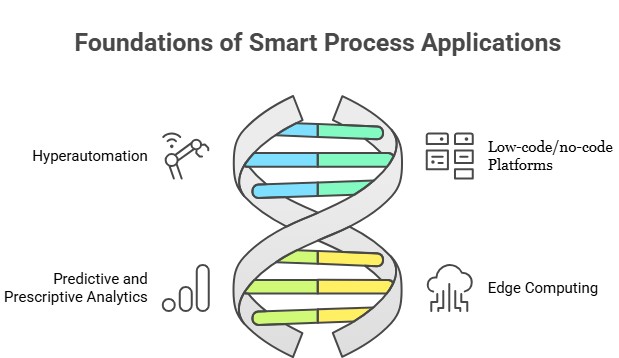
Hyperautomation: Combining AI, RPA, and analytics for end-to-end automation.
Low-code/no-code platforms: Empowering business users to build SPAs with minimal IT support.
Predictive and prescriptive analytics: Using AI to anticipate business challenges.
Edge computing: Enabling real-time decision-making closer to data sources.
These innovations are setting the stage for SPAs to become a core part of digital transformation strategies.
Cloud and AI Solutions: Accelerating the Smart Process Revolution
The Power of the Cloud
Cloud platforms make deploying, scaling, and updating SPAs fast and cost-effective. Benefits include:
Anywhere Access
Cloud-hosted smart process applications empower remote workforces and global operations.
Scalability & Flexibility
Expand as you grow, with no need to overhaul hardware or IT infrastructure.
Continuous Integration
Seamlessly adopt new technologies—AI, IoT, or blockchain—without massive system changes.
AI: The Brains Behind the Automation
AI isn’t just a buzzword; it’s a competitive edge. Here’s how AI is transforming SPAs:
Intelligent Automation
Automate repetitive tasks and trigger workflows based on data patterns or real-time analytics.
Enhanced Decision-Making
AI-powered insights help leaders make smarter, faster calls—boosting efficiency and outcomes.
Personalized Interactions:
From chatbots to predictive recommendations, AI ensures a tailored user experience.
Industry Leaders Driving SPA Innovation
Several companies are spearheading advancements in SPA technology:
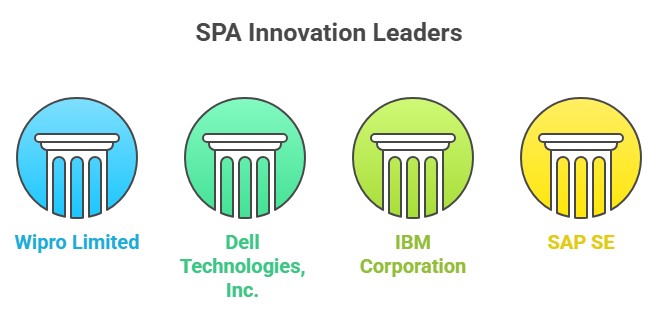
- Wipro Limited: Specializes in AI-powered SPA solutions for enterprise automation.
- Dell Technologies, Inc.: Offers scalable, hybrid-cloud-based SPA frameworks.
- IBM Corporation: Leverages Watson AI for advanced process automation.
- SAP SE: Integrates SPAs into ERP suites for seamless process orchestration.
These innovators are pushing the boundaries of what's possible with SPAs, driving adoption across industries.
Smart Process Applications in Action: Use Cases Across Industries
- Finance: Speed up loan approvals, automate compliance, and enhance customer account management.
- Healthcare: Streamline patient onboarding, optimize billing, and improve patient records management.
- Retail: Personalize offers in real time, automate supply chains, and refine customer service touchpoints.
- Logistics: Track shipments, automate route optimization, and enable real-time inventory management.
Future Outlook: Where Is the Smart Process Applications Market Headed?
Hyper-Personalization: Expect even more granular tailoring of workflows and content, driven by advanced AI.
Low-Code & No-Code Platforms: Businesses of all sizes will adapt processes quickly—often without developer involvement.
Deep Industry Integration: Sectors like healthcare, education, and government will see rapid adoption for both efficiency and compliance.
Conclusion
The smart process applications market is full throttle, fueled by innovation in content management optimization, digital content, and cloud and AI solution integration. Companies investing in these technologies are experiencing faster growth, stronger customer connections, and a genuine edge over competitors.