US Defense Forces Embrace C4ISR: A New Era of Military Intelligence and Control
Published Date : 30-Jul-2025 |
Imagine a world where decisions are made in seconds, where chaos turns into clarity, and every move is guided by an invisible network working silently behind the scenes. That world already exists—and it runs on C4ISR.
Think of it as the brain and nervous system of modern defense and security, connecting people, machines, and data into one sharp, seamless response. It’s not just about the military anymore; it’s shaping how nations protect themselves and how organizations stay a step ahead of danger.
In this blog, we break down:
- What C4ISR systems are
- Market growth trends through 2025
- Key use cases in defense and homeland security
- And the companies dominating this space
What C4ISR Systems Are And Why They Matter
Let’s make it simple.
Imagine trying to win a battle without knowing your enemy’s location, without GPS, without instant communication, and with no satellite data.
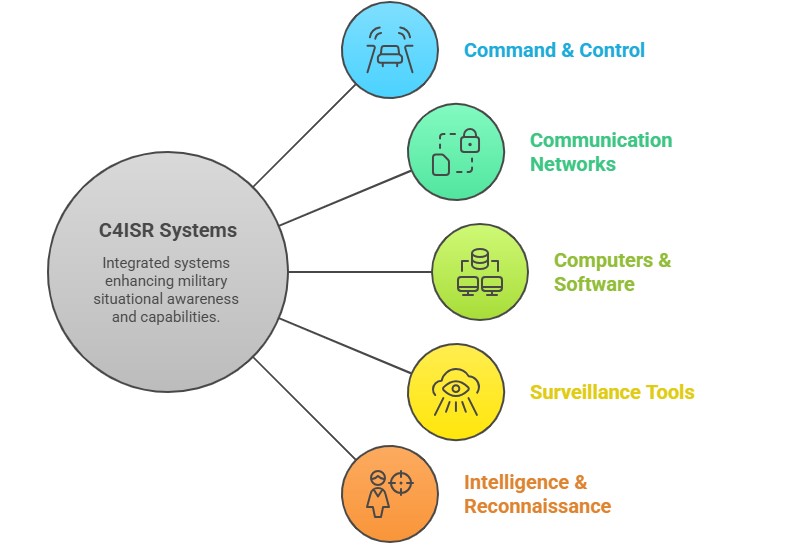
- C4ISR systems solve this problem by offering:
- Command & Control: Gives real-time situational awareness
- Communication Networks: Enables secure and rapid info exchange
- Computers & Software: Helps process huge volumes of data
- Surveillance Tools: From drones to satellites, for eyes on the ground and in the sky
- Intelligence & Reconnaissance: Turn raw data into strategic insights
Global C4ISR Market – More Than Just Military Jargon
If you think C4ISR is just another military acronym, think again.
The Global C4ISR Market size is expected to reach $181.49 billion by 2032, rising at a market growth of 4.7% CAGR during the forecast period.
That’s nearly the size of the economy of a small country. These systems aren’t only about warfare—they’re redefining how nations, governments, and even corporations secure themselves and make data-driven decisions.
“If you don’t have information dominance, you’re going to be blind, deaf, and dumb in the battlefield.” — Gen. James Mattis
Who Are the Front-Runners in the Global C4ISR Market?
Several defense tech leaders are pushing the boundaries of what's possible. Here's a closer look at some prominent forces in the market:
Axis Communications AB (Canon, Inc.)
Known for advanced video surveillance solutions used in border control, public safety, and urban security.
Motorola Solutions, Inc.
A major player in secure communications and mission-critical infrastructure, supporting emergency services and military operations.
Hangzhou Hikvision Digital Technology Co., Ltd.
While best known for commercial surveillance, their military-grade C4ISR solutions are being adopted globally.
Bosch Sicherheits systeme GmbH (Robert Bosch GmbH)
Delivers ruggedized, intelligent sensor networks and AI-powered surveillance solutions.
These companies, among others, are rethinking how we interpret and act on battlefield intelligence.
Where Is the Market Growing Fastest?
With rising geopolitical tensions in the South China Sea, India-China border, and North Korea, the Asia-Pacific region is seeing the fastest C4ISR adoption.
North America: The Powerhouse of the C4ISR market
Here’s a striking fact:
The North America region dominated the Global C4ISR Market by Region in 2024, thereby, achieving a market value of $66.35 Billion by 2032.
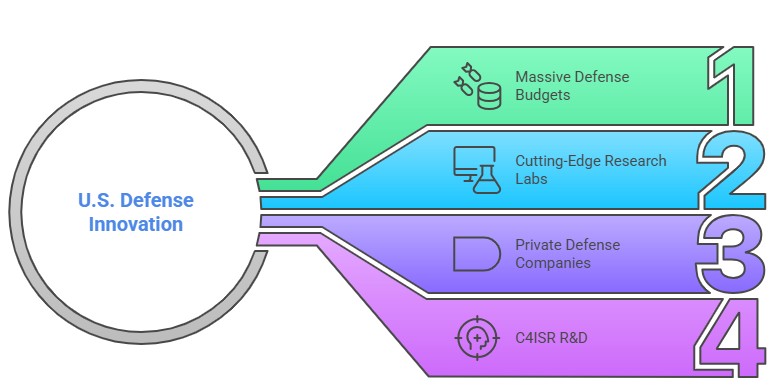
Why does North America lead?
It’s simple. Massive defense budgets, cutting-edge research labs, and a network of private defense companies drive innovation faster here than anywhere else in the world.
In 2025, the U.S. defense sector is doubling down on C4ISR R&D—not just to outpace adversaries, but to build a battlefield brain where intelligence, speed, and precision converge in real time.
Countries like:
- India are investing in real-time border surveillance
- Japan is upgrading air defense systems
- Australia is focusing on joint command operations with allied forces
How C4ISR Systems Are Used Beyond Military Scenarios
You might think C4ISR is only for combat zones—but that’s no longer true.
Here are surprising use cases:
Disaster Response: Helping FEMA coordinate during wildfires or hurricanes
Public Safety: Real-time monitoring in smart cities
Border Management: Tracking illegal crossings or smuggling in real time
Cyber Threat Intelligence: Monitoring network activity for digital intrusions
Trending News in C4ISR
U.S. Air Force Tests AI to Speed Kill Chain Decisions
In July 2025, the U.S. Air Force completed “Experiment 3,” evaluating AI via the Maven Smart System to accelerate target identification and response. Human-machine teaming reduced cognitive load while preserving operator oversight—highlighting AI’s role as a force multiplier, not a replacement .
Counter UAS Command Stack Launched by AirMatrix & Robin
This joint initiative delivers an AI-powered workflow linking drone detection, sensor fusion, command decisioning, and countermeasures in one integrated C4ISR platform—streamlining airspace defense for infrastructure protection.
Challenges Still Loom for C4ISR Adoption
Despite the benefits, adoption isn’t always smooth.
1. Interoperability Issues
With legacy systems still in use, integrating new tech without data loss or lag remains tough.
2. Data Overload
Too much data, not enough actionable insight. AI helps, but human analysis still plays a vital role.
3. High Costs & Procurement Delays
These systems are expensive. Government red tape often slows down the acquisition process.
Final Takeaway
The C4ISR market isn’t just growing—it’s transforming how nations defend, respond, and strategize in real time.From AI and satellites to encrypted networks and predictive analytics, modern warfare—and even civil defense—are getting smarter and faster.
As we head into 2025 and beyond, companies that innovate in this space will shape not just military superiority, but global security and emergency preparedness.