Asia Pacific AI Server Market Size, Share & Industry Analysis Report By Processor Type (GPU-based Servers, FPGA-based Servers, and ASIC-based Servers), By Cooling Technology (Air Cooling, Liquid Cooling, and Hybrid Cooling), By Form Factor (Rack-mounted Servers, Blade Servers, and Tower Servers), By End Use, By Country and Growth Forecast, 2025 - 2032
Published Date : 09-Jul-2025 |
Pages: 206 |
Report Format: PDF + Excel |
COVID-19 Impact on the Asia Pacific AI Server Market
The Asia Pacific AI Server Market would witness market growth of 38.1% CAGR during the forecast period (2025-2032).
The China market dominated the Asia Pacific AI Server Market by Country in 2024, and would continue to be a dominant market till 2032; thereby, achieving a market value of $201,011.2 million by 2032. The Japan market is registering a CAGR of 37.1% during (2025 - 2032). Additionally, The India market would showcase a CAGR of 39.4% during (2025 - 2032).
The Asia Pacific (APAC) region has witnessed a remarkable transformation in its AI server market, driven by rapid digitalization, government initiatives, and the proliferation of AI applications across various industries. Countries like China, Japan, South Korea, and India have been at the forefront, investing heavily in AI infrastructure to support their burgeoning tech ecosystems. For instance, Lenovo announced plans to manufacture AI servers in India and opened an AI-centric R&D lab in Bengaluru, aiming to produce 50,000 AI rack servers and 2,400 GPU servers annually to cater to both domestic and international markets.
The evolution of the AI server market in APAC is also marked by significant investments from major players like Foxconn, which forecasts its AI server revenue to exceed NT$1 trillion by 2025, accounting for 50% of its total server revenue and over 40% market share. Such developments underscore the region's commitment to becoming a global leader in AI technology, with a focus on enhancing computational capabilities and fostering innovation. One prominent trend in the APAC AI server market is the emphasis on digital sovereignty and infrastructure development. Governments across the region are investing in AI infrastructure to ensure data security and reduce dependency on foreign technologies.
Free Valuable Insights: The Global AI Server Market is Predict to reach USD 1.6 Trillion by 2032, at a CAGR of 37.5%
Asia Pacific AI Server Market Trends
Asia Pacific has emerged as the fastest-growing region in the global AI server market, driven by robust economic digitalization, tech-centric policy frameworks, AI-powered industrial automation, and increasing investments from global cloud service providers. Countries like China, Japan, India, South Korea, Singapore, and Australia are at the forefront of AI infrastructure development, creating a diverse and expansive market landscape for AI servers.
1. China’s National Drive for AI Infrastructure Expansion
China leads AI server deployment in APAC through massive government-backed initiatives and industrial-scale adoption:
China’s emphasis on sovereign AI compute aligns with its broader digital sovereignty goals and is significantly accelerating server demand.
2. India’s Public Sector AI and Digital Mission Momentum
India is actively developing its AI server ecosystem through national initiatives focused on public welfare, digital services, and industrial automation:
India’s low power costs and skilled engineering workforce further enhance its appeal for AI server investments.
State of Competition in the Asia Pacific AI Server Market
The Asia Pacific (APAC) region is rapidly evolving into one of the most competitive AI server markets globally. Fueled by government-backed infrastructure rollouts, hyperscaler expansions, and indigenous hardware innovation, APAC’s competitive landscape is shaped by both domestic technology champions and global entrants adapting to regional demands. The diversity across economies—from highly industrialized nations like Japan and South Korea to fast-emerging digital economies in Southeast Asia—makes the competition multi-faceted and dynamic.
1. China’s Homegrown Server and AI Chip Ecosystem
China is aggressively advancing self-reliance in AI server infrastructure through both state policy and corporate execution:
China’s AI server market is increasingly sovereign, competitive, and strategically shielded from external vendors.
2. Japan and South Korea’s High-Performance AI Ecosystems
Japan and South Korea are investing heavily in AI server systems to support automation, smart cities, and advanced robotics:
In both countries, AI servers are increasingly designed for specific use cases—medical imaging, traffic management, or factory automation—enhancing product-level competition.
Processor Type Outlook
Based on the Processor Type, the AI server market is segmented into GPU-based, FPGA-based, and ASIC-based servers. The GPU-Based Servers held the major market share among all the processor types in 2024 followed by FPGA-based Servers.
1. GPU-Based Servers
Trend: The Asia-Pacific region is experiencing significant growth in the adoption of GPU-based servers, driven by the increasing demand for AI applications and the need for high-performance computing.
To illustrate:
- Singtel, a leading telecommunications company in Singapore, announced plans to launch its GPU-as-a-Service (GPUaaS) in Southeast Asia. This service will provide enterprises with access to NVIDIA's AI computing power, facilitating accelerated growth and innovation. The initiative underscores the region's commitment to enhancing AI capabilities through advanced GPU infrastructure.
2. FPGA-Based Servers
Trend: FPGA-based servers are gaining traction in the Asia-Pacific region, particularly in telecommunications and automotive sectors, due to their flexibility and efficiency in handling specific AI workloads.
To illustrate:
- Vodafone and AMD's 5G Infrastructure Development: Vodafone is collaborating with AMD to develop next-generation mobile base stations using AMD's Zynq UltraScale+ RFSoC devices, aiming to enhance 5G infrastructure efficiency.
Cooling Type Outlook
Based on Cooling Technology, the market is segmented into Air Cooling, Liquid Cooling, and Hybrid Cooling.
Air Cooling
Trend: Continued dominance of air-based cooling, evolving through free and economized cooling methods in high-density installations.
To illustrate:
- Free-air/economized cooling in China and Japan: Data centers are increasingly leveraging outside air for cooling, reducing dependency on mechanical chillers. Facilities in China and Japan are noted for this rising implementation of “free cooling” to optimize energy usage.
Liquid Cooling
Trend: Rapid adoption of liquid cooling—especially immersion—driven by rising AI compute density and energy efficiency.
To illustrate:
- Surge in direct liquid and immersion cooling: In APAC, immersion techniques were already capturing a third of the cooling market and continue to grow substantially.
Form Factor Outlook
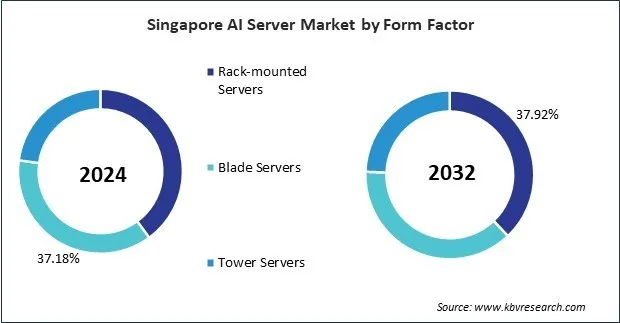
Based on Form Factor, the Asia Pacific AI Server Market is segmented into Rack-mounted servers, Blade Servers, and Tower servers segment. The Rack mounted server segment garnered the highest revenue share among others in 2024 in Asia Pacific AI Server Market.
Rack-Mounted Servers
Trend: Rack-mounted servers are widely adopted in the APAC region due to their scalability and efficient space utilization, making them ideal for data centers and enterprise environments.
To illustrate:
- Amazon's Investment in Taiwan: Amazon Web Services (AWS) announced plans to invest over $5 billion in the Asia Pacific (Taipei) Region, supporting the construction and operation of data centers in Taiwan. This significant investment underscores the growing demand for scalable rack-mounted server configurations to support regional cloud and AI services.
Blade Servers
Trend: Blade servers are gaining traction in the APAC region, particularly in environments requiring high-density computing and efficient resource utilization, such as virtualization and cloud computing.
To illustrate:
- AirTrunk's Expansion: AirTrunk, a leading data center operator, has expanded its presence across the APAC region, including Australia, Japan, Malaysia, Hong Kong, and Singapore. The company's growth reflects the increasing demand for high-density computing solutions like blade servers to support AI and cloud workloads.
End Use Outlook
Based on the End Use, the Asia Pacific AI Server Market is segmented into IT & Telecommunication, BFSI, Retail & E-commerce, Healthcare & Pharmaceutical, Automotive and Other End Use. The IT & Telecommunication segment garnered the largest revenue share in Asia Pacific market followed by BFSI and Retail & E-commerce among all other end use verticals.
IT & Telecommunication
Trend: The Asia-Pacific region is experiencing rapid growth in AI server adoption within the IT and telecommunication sector, driven by the expansion of 5G networks and the increasing demand for edge computing solutions. Telecom companies are leveraging AI to enhance network operations, customer service, and business intelligence.
To illustrate:
- Thailand's AIS has integrated AI across over half of its network sites, resulting in a 4.4% reduction in energy consumption and a 2% decrease in utility expenses. Their AI-powered customer service solutions handle over a quarter of all customer interactions, achieving a 94% customer satisfaction rate.
BFSI (Banking, Financial Services, and Insurance)
Trend:The BFSI sector in Asia-Pacific is increasingly adopting AI servers to enhance operational efficiency, customer experience, and risk management. Financial institutions are integrating AI to automate processes and provide personalized services.
To illustrate:
- India's BFSI sector is undergoing a transformative shift with the integration of Agentic AI, enabling systems to autonomously interpret scenarios, adapt to new data, and initiate real-time actions with minimal human involvement. This advanced AI is revolutionizing customer engagement, risk management, and operational efficiency within financial institutions.
Based on Processor Type, the market is segmented into GPU-based Servers, FPGA-based Servers, and ASIC-based Servers. Based on Cooling Technology, the market is segmented into Air Cooling, Liquid Cooling, and Hybrid Cooling. Based on Form Factor, the market is segmented into Rack-mounted Servers, Blade Servers, and Tower Servers. Based on End Use, the market is segmented into IT & Telecommunication, BFSI, Retail & E-commerce, Healthcare & Pharmaceutical, Automotive, and Other End Use. Based on countries, the market is segmented into China, Japan, India, South Korea, Singapore, Malaysia, and Rest of Asia Pacific.
List of Key Companies Profiled
- Dell Technologies, Inc.
- Cisco Systems, Inc.
- IBM Corporation
- HP Inc.
- Huawei Technologies Co., Ltd. (Huawei Investment & Holding Co., Ltd.)
- NVIDIA Corporation
- Fujitsu Limited
- Intel Corporation
- Microsoft Corporation
- Salesforce, Inc.
Asia Pacific AI Server Market Report Segmentation
By Processor Type
- GPU-based Servers
- FPGA-based Servers
- ASIC-based Servers
By Cooling Technology
- Air Cooling
- Liquid Cooling
- Hybrid Cooling
By Form Factor
- Rack-mounted Servers
- Blade Servers
- Tower Servers
By End Use
- IT & Telecommunication
- BFSI
- Retail & E-commerce
- Healthcare & Pharmaceutical
- Automotive
- Other End Use
By Country
- China
- Japan
- India
- South Korea
- Singapore
- Malaysia
- Rest of Asia Pacific
1.1 Market Definition
1.2 Objectives
1.3 Market Scope
1.4 Segmentation
1.4.1 Asia Pacific AI Server Market, by Processor Type
1.4.2 Asia Pacific AI Server Market, by Cooling Technology
1.4.3 Asia Pacific AI Server Market, by Form Factor
1.4.4 Asia Pacific AI Server Market, by End Use
1.4.5 Asia Pacific AI Server Market, by Country
1.5 Methodology for the research
Chapter 2. Market at a Glance
2.1 Key Highlights
Chapter 3. Market Overview
3.1 Introduction
3.1.1 Overview
3.1.1.1 Market Composition and Scenario
3.2 Key Factors Impacting the Market
3.2.1 Market Drivers
3.2.1 Market Restraints
3.2.2 Market Opportunities
3.2.3 Market Challenges
Chapter 4. Asia Pacific Market Trends
Chapter 5. State of Competition in the Asia Pacific AI Server Market
Chapter 6. AI Server Market - Consolidation Analysis
Chapter 7. Product Life Cycle Analysis: AI Server Market
Chapter 8. Competition Analysis - Global
8.1 KBV Cardinal Matrix
8.2 Recent Industry Wide Strategic Developments
8.2.1 Partnerships, Collaborations and Agreements
8.2.2 Product Launches and Product Expansions
8.2.3 Acquisition and Mergers
8.3 Market Share Analysis, 2024
8.4 Top Winning Strategies
8.4.1 Key Leading Strategies: Percentage Distribution (2021-2025)
8.4.2 Key Strategic Move: (Partnerships, Collaborations & Agreements: 2024, Mar – 2025, May) Leading Players
8.5 Porter Five Forces Analysis
Chapter 9. Value Chain Analysis of AI Server Market
Chapter 10. Key Customer Criteria: AI Server Market
10.1 Performance and Compute Capability
10.2 Scalability and Density Optimization
10.3 Hybrid Cloud and Edge Integration
10.4 Vendor Ecosystem and Support
Chapter 11. Asia Pacific AI Server Market by Processor Type
11.1 Asia Pacific GPU-based Servers Market by Country
11.2 Asia Pacific FPGA-based Servers Market by Country
11.3 Asia Pacific ASIC-based Servers Market by Country
Chapter 12. Asia Pacific AI Server Market by Cooling Technology
12.1 Asia Pacific Air Cooling Market by Country
12.2 Asia Pacific Liquid Cooling Market by Country
12.3 Asia Pacific Hybrid Cooling Market by Country
Chapter 13. Asia Pacific AI Server Market by Form Factor
13.1 Asia Pacific Rack-mounted Servers Market by Country
13.2 Asia Pacific Blade Servers Market by Country
13.3 Asia Pacific Tower Servers Market by Country
Chapter 14. Asia Pacific AI Server Market by End Use
14.1 Asia Pacific IT & Telecommunication Market by Country
14.2 Asia Pacific BFSI Market by Country
14.3 Asia Pacific Retail & E-commerce Market by Country
14.4 Asia Pacific Healthcare & Pharmaceutical Market by Country
14.5 Asia Pacific Automotive Market by Country
14.6 Asia Pacific Other End Use Market by Country
15.1 China AI Server Market
Chapter 15. Asia Pacific AI Server Market by Country
15.1.1 China AI Server Market by Processor Type
15.1.2 China AI Server Market by Cooling Technology
15.1.3 China AI Server Market by Form Factor
15.1.4 China AI Server Market by End Use
15.2 Japan AI Server Market
15.2.1 Japan AI Server Market by Processor Type
15.2.2 Japan AI Server Market by Cooling Technology
15.2.3 Japan AI Server Market by Form Factor
15.2.4 Japan AI Server Market by End Use
15.3 India AI Server Market
15.3.1 India AI Server Market by Processor Type
15.3.2 India AI Server Market by Cooling Technology
15.3.3 India AI Server Market by Form Factor
15.3.4 India AI Server Market by End Use
15.4 South Korea AI Server Market
15.4.1 South Korea AI Server Market by Processor Type
15.4.2 South Korea AI Server Market by Cooling Technology
15.4.3 South Korea AI Server Market by Form Factor
15.4.4 South Korea AI Server Market by End Use
15.5 Singapore AI Server Market
15.5.1 Singapore AI Server Market by Processor Type
15.5.2 Singapore AI Server Market by Cooling Technology
15.5.3 Singapore AI Server Market by Form Factor
15.5.4 Singapore AI Server Market by End Use
15.6 Malaysia AI Server Market
15.6.1 Malaysia AI Server Market by Processor Type
15.6.2 Malaysia AI Server Market by Cooling Technology
15.6.3 Malaysia AI Server Market by Form Factor
15.6.4 Malaysia AI Server Market by End Use
15.7 Rest of Asia Pacific AI Server Market
15.7.1 Rest of Asia Pacific AI Server Market by Processor Type
15.7.2 Rest of Asia Pacific AI Server Market by Cooling Technology
15.7.3 Rest of Asia Pacific AI Server Market by Form Factor
15.7.4 Rest of Asia Pacific AI Server Market by End Use
Chapter 16. Company Profiles
16.1 Dell Technologies, Inc.
16.1.1 Company Overview
16.1.2 Financial Analysis
16.1.3 Segmental and Regional Analysis
16.1.4 Research & Development Expense
16.1.5 Recent strategies and developments:
16.1.5.1 Partnerships, Collaborations, and Agreements:
16.1.6 SWOT Analysis
16.2 Cisco Systems, Inc.
16.2.1 Company Overview
16.2.2 Financial Analysis
16.2.3 Regional Analysis
16.2.4 Research & Development Expense
16.2.5 Recent strategies and developments:
16.2.5.1 Partnerships, Collaborations, and Agreements:
16.2.5.2 Product Launches and Product Expansions:
16.2.6 SWOT Analysis
16.3 IBM Corporation
16.3.1 Company Overview
16.3.2 Financial Analysis
16.3.3 Regional & Segmental Analysis
16.3.4 Research & Development Expenses
16.3.5 Recent strategies and developments:
16.3.5.1 Product Launches and Product Expansions:
16.3.6 SWOT Analysis
16.4 HP, Inc.
16.4.1 Company Overview
16.4.2 Financial Analysis
16.4.3 Segmental and Regional Analysis
16.4.4 Research & Development Expense
16.4.5 Recent strategies and developments:
16.4.5.1 Partnerships, Collaborations, and Agreements:
16.4.5.2 Acquisition and Mergers:
16.4.6 SWOT Analysis
16.5 Huawei Technologies Co., Ltd. (Huawei Investment & Holding Co., Ltd.)
16.5.1 Company Overview
16.5.2 Financial Analysis
16.5.3 Segmental and Regional Analysis
16.5.4 Research & Development Expenses
16.5.5 Recent strategies and developments:
16.5.5.1 Product Launches and Product Expansions:
16.5.6 SWOT Analysis
16.6 NVIDIA Corporation
16.6.1 Company Overview
16.6.2 Financial Analysis
16.6.3 Segmental and Regional Analysis
16.6.4 Research & Development Expenses
16.6.5 Recent strategies and developments:
16.6.5.1 Partnerships, Collaborations, and Agreements:
16.6.5.2 Product Launches and Product Expansions:
16.6.6 SWOT Analysis
16.7 Fujitsu Limited
16.7.1 Company Overview
16.7.2 Financial Analysis
16.7.3 Segmental and Regional Analysis
16.7.4 Research & Development Expenses
16.7.5 Recent strategies and developments:
16.7.5.1 Partnerships, Collaborations, and Agreements:
16.7.6 SWOT Analysis
16.8 Intel Corporation
16.8.1 Company Overview
16.8.2 Financial Analysis
16.8.3 Segmental and Regional Analysis
16.8.4 Research & Development Expenses
16.8.5 Recent strategies and developments:
16.8.5.1 Product Launches and Product Expansions:
16.8.6 SWOT Analysis
16.9 Microsoft Corporation
16.9.1 Company Overview
16.9.2 Financial Analysis
16.9.3 Segmental and Regional Analysis
16.9.4 Research & Development Expenses
16.9.5 Recent strategies and developments:
16.9.5.1 Partnerships, Collaborations, and Agreements:
16.9.6 SWOT Analysis
16.10. Salesforce, Inc.
16.10.1 Company Overview
16.10.2 Financial Analysis
16.10.3 Regional Analysis
16.10.4 Research & Development Expenses
16.10.5 Recent strategies and developments:
16.10.5.1 Acquisition and Mergers:
16.10.6 SWOT Analysis
TABLE 2 Asia Pacific AI Server Market, 2025 - 2032, USD Million
TABLE 3 Evaluation of Parameters: AI Server Market
TABLE 4 Partnerships, Collaborations and Agreements– AI Server Market
TABLE 5 Product Launches And Product Expansions– AI Server Market
TABLE 6 Acquisition and Mergers– AI Server Market
TABLE 7 Key Customer Criteria: AI Server Market
TABLE 8 Asia Pacific AI Server Market by Processor Type, 2021 - 2024, USD Million
TABLE 9 Asia Pacific AI Server Market by Processor Type, 2025 - 2032, USD Million
TABLE 10 Asia Pacific GPU-based Servers Market by Country, 2021 - 2024, USD Million
TABLE 11 Asia Pacific GPU-based Servers Market by Country, 2025 - 2032, USD Million
TABLE 12 Asia Pacific FPGA-based Servers Market by Country, 2021 - 2024, USD Million
TABLE 13 Asia Pacific FPGA-based Servers Market by Country, 2025 - 2032, USD Million
TABLE 14 Asia Pacific ASIC-based Servers Market by Country, 2021 - 2024, USD Million
TABLE 15 Asia Pacific ASIC-based Servers Market by Country, 2025 - 2032, USD Million
TABLE 16 Asia Pacific AI Server Market by Cooling Technology, 2021 - 2024, USD Million
TABLE 17 Asia Pacific AI Server Market by Cooling Technology, 2025 - 2032, USD Million
TABLE 18 Asia Pacific Air Cooling Market by Country, 2021 - 2024, USD Million
TABLE 19 Asia Pacific Air Cooling Market by Country, 2025 - 2032, USD Million
TABLE 20 Asia Pacific Liquid Cooling Market by Country, 2021 - 2024, USD Million
TABLE 21 Asia Pacific Liquid Cooling Market by Country, 2025 - 2032, USD Million
TABLE 22 Asia Pacific Hybrid Cooling Market by Country, 2021 - 2024, USD Million
TABLE 23 Asia Pacific Hybrid Cooling Market by Country, 2025 - 2032, USD Million
TABLE 24 Asia Pacific AI Server Market by Form Factor, 2021 - 2024, USD Million
TABLE 25 Asia Pacific AI Server Market by Form Factor, 2025 - 2032, USD Million
TABLE 26 Asia Pacific Rack-mounted Servers Market by Country, 2021 - 2024, USD Million
TABLE 27 Asia Pacific Rack-mounted Servers Market by Country, 2025 - 2032, USD Million
TABLE 28 Asia Pacific Blade Servers Market by Country, 2021 - 2024, USD Million
TABLE 29 Asia Pacific Blade Servers Market by Country, 2025 - 2032, USD Million
TABLE 30 Asia Pacific Tower Servers Market by Country, 2021 - 2024, USD Million
TABLE 31 Asia Pacific Tower Servers Market by Country, 2025 - 2032, USD Million
TABLE 32 Asia Pacific AI Server Market by End Use, 2021 - 2024, USD Million
TABLE 33 Asia Pacific AI Server Market by End Use, 2025 - 2032, USD Million
TABLE 34 Asia Pacific IT & Telecommunication Market by Country, 2021 - 2024, USD Million
TABLE 35 Asia Pacific IT & Telecommunication Market by Country, 2025 - 2032, USD Million
TABLE 36 Asia Pacific BFSI Market by Country, 2021 - 2024, USD Million
TABLE 37 Asia Pacific BFSI Market by Country, 2025 - 2032, USD Million
TABLE 38 Asia Pacific Retail & E-commerce Market by Country, 2021 - 2024, USD Million
TABLE 39 Asia Pacific Retail & E-commerce Market by Country, 2025 - 2032, USD Million
TABLE 40 Asia Pacific Healthcare & Pharmaceutical Market by Country, 2021 - 2024, USD Million
TABLE 41 Asia Pacific Healthcare & Pharmaceutical Market by Country, 2025 - 2032, USD Million
TABLE 42 Asia Pacific Automotive Market by Country, 2021 - 2024, USD Million
TABLE 43 Asia Pacific Automotive Market by Country, 2025 - 2032, USD Million
TABLE 44 Asia Pacific Other End Use Market by Country, 2021 - 2024, USD Million
TABLE 45 Asia Pacific Other End Use Market by Country, 2025 - 2032, USD Million
TABLE 46 Asia Pacific AI Server Market by Country, 2021 - 2024, USD Million
TABLE 47 Asia Pacific AI Server Market by Country, 2025 - 2032, USD Million
TABLE 48 China AI Server Market, 2021 - 2024, USD Million
TABLE 49 China AI Server Market, 2025 - 2032, USD Million
TABLE 50 China AI Server Market by Processor Type, 2021 - 2024, USD Million
TABLE 51 China AI Server Market by Processor Type, 2025 - 2032, USD Million
TABLE 52 China AI Server Market by Cooling Technology, 2021 - 2024, USD Million
TABLE 53 China AI Server Market by Cooling Technology, 2025 - 2032, USD Million
TABLE 54 China AI Server Market by Form Factor, 2021 - 2024, USD Million
TABLE 55 China AI Server Market by Form Factor, 2025 - 2032, USD Million
TABLE 56 China AI Server Market by End Use, 2021 - 2024, USD Million
TABLE 57 China AI Server Market by End Use, 2025 - 2032, USD Million
TABLE 58 Japan AI Server Market, 2021 - 2024, USD Million
TABLE 59 Japan AI Server Market, 2025 - 2032, USD Million
TABLE 60 Japan AI Server Market by Processor Type, 2021 - 2024, USD Million
TABLE 61 Japan AI Server Market by Processor Type, 2025 - 2032, USD Million
TABLE 62 Japan AI Server Market by Cooling Technology, 2021 - 2024, USD Million
TABLE 63 Japan AI Server Market by Cooling Technology, 2025 - 2032, USD Million
TABLE 64 Japan AI Server Market by Form Factor, 2021 - 2024, USD Million
TABLE 65 Japan AI Server Market by Form Factor, 2025 - 2032, USD Million
TABLE 66 Japan AI Server Market by End Use, 2021 - 2024, USD Million
TABLE 67 Japan AI Server Market by End Use, 2025 - 2032, USD Million
TABLE 68 India AI Server Market, 2021 - 2024, USD Million
TABLE 69 India AI Server Market, 2025 - 2032, USD Million
TABLE 70 India AI Server Market by Processor Type, 2021 - 2024, USD Million
TABLE 71 India AI Server Market by Processor Type, 2025 - 2032, USD Million
TABLE 72 India AI Server Market by Cooling Technology, 2021 - 2024, USD Million
TABLE 73 India AI Server Market by Cooling Technology, 2025 - 2032, USD Million
TABLE 74 India AI Server Market by Form Factor, 2021 - 2024, USD Million
TABLE 75 India AI Server Market by Form Factor, 2025 - 2032, USD Million
TABLE 76 India AI Server Market by End Use, 2021 - 2024, USD Million
TABLE 77 India AI Server Market by End Use, 2025 - 2032, USD Million
TABLE 78 South Korea AI Server Market, 2021 - 2024, USD Million
TABLE 79 South Korea AI Server Market, 2025 - 2032, USD Million
TABLE 80 South Korea AI Server Market by Processor Type, 2021 - 2024, USD Million
TABLE 81 South Korea AI Server Market by Processor Type, 2025 - 2032, USD Million
TABLE 82 South Korea AI Server Market by Cooling Technology, 2021 - 2024, USD Million
TABLE 83 South Korea AI Server Market by Cooling Technology, 2025 - 2032, USD Million
TABLE 84 South Korea AI Server Market by Form Factor, 2021 - 2024, USD Million
TABLE 85 South Korea AI Server Market by Form Factor, 2025 - 2032, USD Million
TABLE 86 South Korea AI Server Market by End Use, 2021 - 2024, USD Million
TABLE 87 South Korea AI Server Market by End Use, 2025 - 2032, USD Million
TABLE 88 Singapore AI Server Market, 2021 - 2024, USD Million
TABLE 89 Singapore AI Server Market, 2025 - 2032, USD Million
TABLE 90 Singapore AI Server Market by Processor Type, 2021 - 2024, USD Million
TABLE 91 Singapore AI Server Market by Processor Type, 2025 - 2032, USD Million
TABLE 92 Singapore AI Server Market by Cooling Technology, 2021 - 2024, USD Million
TABLE 93 Singapore AI Server Market by Cooling Technology, 2025 - 2032, USD Million
TABLE 94 Singapore AI Server Market by Form Factor, 2021 - 2024, USD Million
TABLE 95 Singapore AI Server Market by Form Factor, 2025 - 2032, USD Million
TABLE 96 Singapore AI Server Market by End Use, 2021 - 2024, USD Million
TABLE 97 Singapore AI Server Market by End Use, 2025 - 2032, USD Million
TABLE 98 Malaysia AI Server Market, 2021 - 2024, USD Million
TABLE 99 Malaysia AI Server Market, 2025 - 2032, USD Million
TABLE 100 Malaysia AI Server Market by Processor Type, 2021 - 2024, USD Million
TABLE 101 Malaysia AI Server Market by Processor Type, 2025 - 2032, USD Million
TABLE 102 Malaysia AI Server Market by Cooling Technology, 2021 - 2024, USD Million
TABLE 103 Malaysia AI Server Market by Cooling Technology, 2025 - 2032, USD Million
TABLE 104 Malaysia AI Server Market by Form Factor, 2021 - 2024, USD Million
TABLE 105 Malaysia AI Server Market by Form Factor, 2025 - 2032, USD Million
TABLE 106 Malaysia AI Server Market by End Use, 2021 - 2024, USD Million
TABLE 107 Malaysia AI Server Market by End Use, 2025 - 2032, USD Million
TABLE 108 Rest of Asia Pacific AI Server Market, 2021 - 2024, USD Million
TABLE 109 Rest of Asia Pacific AI Server Market, 2025 - 2032, USD Million
TABLE 110 Rest of Asia Pacific AI Server Market by Processor Type, 2021 - 2024, USD Million
TABLE 111 Rest of Asia Pacific AI Server Market by Processor Type, 2025 - 2032, USD Million
TABLE 112 Rest of Asia Pacific AI Server Market by Cooling Technology, 2021 - 2024, USD Million
TABLE 113 Rest of Asia Pacific AI Server Market by Cooling Technology, 2025 - 2032, USD Million
TABLE 114 Rest of Asia Pacific AI Server Market by Form Factor, 2021 - 2024, USD Million
TABLE 115 Rest of Asia Pacific AI Server Market by Form Factor, 2025 - 2032, USD Million
TABLE 116 Rest of Asia Pacific AI Server Market by End Use, 2021 - 2024, USD Million
TABLE 117 Rest of Asia Pacific AI Server Market by End Use, 2025 - 2032, USD Million
TABLE 118 Key Information – Dell Technologies, Inc.
TABLE 119 Key Information – Cisco Systems, Inc.
TABLE 120 Key Information – IBM Corporation
TABLE 121 Key Information – HP, Inc.
TABLE 122 Key Information – Huawei Technologies Co., Ltd.
TABLE 123 Key Information – NVIDIA Corporation
TABLE 124 Key Information – Fujitsu Limited
TABLE 125 Key Information – Intel Corporation
TABLE 126 Key Information – Microsoft Corporation
TABLE 127 Key Information – Salesforce, Inc.
List of Figures
FIG 1 Methodology for the research
FIG 2 Asia Pacific AI Server Market, 2021 - 2032, USD Million
FIG 3 Key Factors Impacting AI Server Market
FIG 4 Market Consolidation Analysis
FIG 5 Product Life Cycle Analysis
FIG 6 KBV Cardinal Matrix
FIG 7 Market Share Analysis, 2024
FIG 8 Key Leading Strategies: Percentage Distribution (2021-2025)
FIG 9 Key Strategic Move: (Partnerships, Collaborations & Agreements: 2017, Jun – 2021, Jun) Leading Players
FIG 10 Porter’s Five Forces Analysis – Energy-efficient Industrial Cooling Systems Market
FIG 11 Value Chain Analysis of AI Server Market
FIG 12 Key Customer Criteria: AI Server Market
FIG 13 Asia Pacific AI Server Market share by Processor Type, 2024
FIG 14 Asia Pacific AI Server Market share by Processor Type, 2032
FIG 15 Asia Pacific AI Server Market by Processor Type, 2021 - 2032, USD Million
FIG 16 Asia Pacific AI Server Market share by Cooling Technology, 2024
FIG 17 Asia Pacific AI Server Market share by Cooling Technology, 2032
FIG 18 Asia Pacific AI Server Market by Cooling Technology, 2021 - 2032, USD Million
FIG 19 Asia Pacific AI Server Market share by Form Factor, 2024
FIG 20 Asia Pacific AI Server Market share by Form Factor, 2032
FIG 21 Asia Pacific AI Server Market by Form Factor, 2021 - 2032, USD Million
FIG 22 Asia Pacific AI Server Market share by End Use, 2024
FIG 23 Asia Pacific AI Server Market share by End Use, 2032
FIG 24 Asia Pacific AI Server Market by End Use, 2021 - 2032, USD Million
FIG 25 Asia Pacific AI Server Market share by Country, 2024
FIG 26 Asia Pacific AI Server Market share by Country, 2032
FIG 27 Asia Pacific AI Server Market by Country, 2021 - 2032, USD Million
FIG 28 SWOT Analysis: Dell Technologies, Inc.
FIG 29 Recent strategies and developments: CISCO SYSTEMS, INC.
FIG 30 SWOT Analysis: Cisco Systems, Inc.
FIG 31 SWOT Analysis: IBM Corporation
FIG 32 Recent strategies and developments: HP, Inc.
FIG 33 SWOT Analysis: HP, Inc.
FIG 34 SWOT Analysis: Huawei Technologies Co., Ltd.
FIG 35 Recent strategies and developments: NVIDIA Corporation
FIG 36 SWOT Analysis: NVIDIA Corporation
FIG 37 Swot analysis: Fujitsu Limited
FIG 38 SWOT Analysis: Intel corporation
FIG 39 SWOT Analysis: Microsoft Corporation
FIG 40 SWOT Analysis: Salesforce, Inc.